BISU
由我校党委宣传部、中国网新闻评论部、北京日报社国际传播部共同出品的《我眼中的北京非遗》第二季——《大运河上的北京非遗》系列融媒体作品,于2026年1月20日正式发布。该系列作品旨在推动北京非物质文化遗产的国际传播与活态传承,通过中国网、北京日报客户端、北京电视台客户端以及我校海内外媒体矩阵同步播出。
我们将陆续推出该系列融媒体作品,带领广大师生、校友和社会各界朋友,沿着大运河流动的文脉,一同走进北京非遗的生动现场,感受其跨越时空的生命力与创造力。让我们共同关注、参与传播,在光影与故事中深化对中华优秀传统文化的理解与热爱,助力北京非遗走向更广阔的世界舞台。
如果说《西游记》里金角大王、银角大王的葫芦,一声“应我一声”便能收尽乾坤,那么另一只诞生在北京三间房地区的葫芦里装下的,则是时间、手艺与匠人的一生。
If, in Journey to the West, the gourds of the Gold-Horned and Silver-Horned Kings could capture all in the universe with a single call—“Answer me!”—then another gourd born in Beijing’s Sanjianfang area holds within it time, craftsmanship, and a lifetime’s devotion.
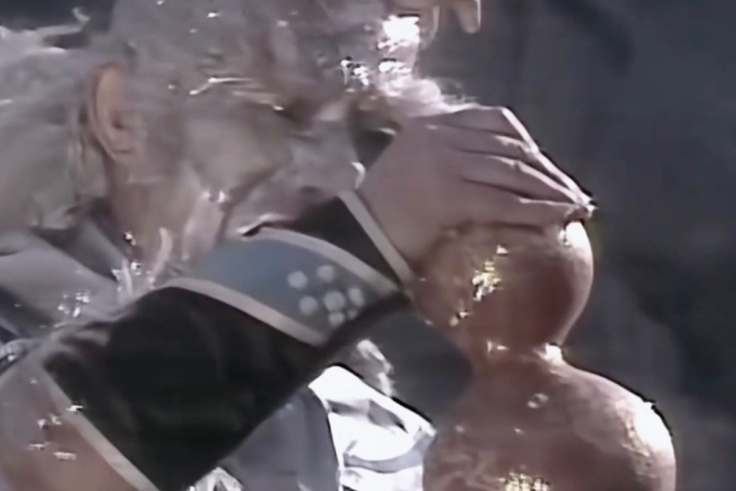
《西游记》剧照
Still from Journey to the West
这里的阳光总来得格外温和。三间房一带自古便是“文化之乡”,毛猴、空竹、京剧脸谱、国画与各色非遗在此共生。康驹祥的工作室便安静藏于其间。
The sunlight here always feels extraordinarily gentle. Sanjianfang has long been known as a “village of culture”, where such folk arts as hairy monkey figurines, diabolo spinning, Peking Opera masks, Chinese ink painting, and many forms of intangible cultural heritage have lived side by side. Kang Juxiang’s studio lies quietly among them.
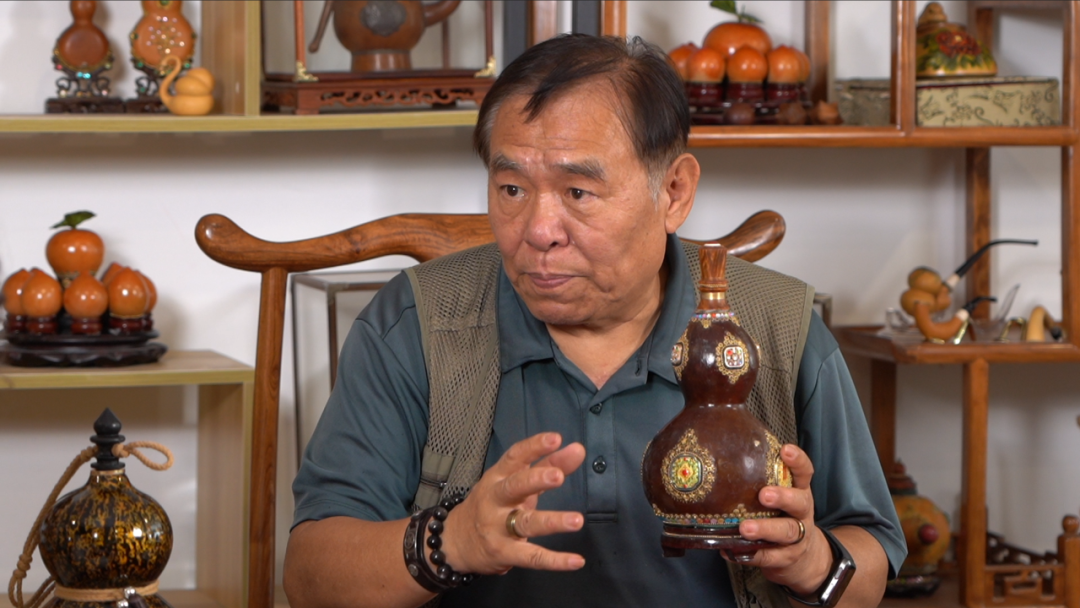
康驹祥,葫芦镶嵌国家级非物质文化遗产代表性传承人。祖辈曾供职宫廷,为御用工匠。家族最早技艺不在葫芦,而在家具——明清时大户人家家具尚“百宝嵌”,于木料上镶螺钿、嵌石料,日光映照,光影流转。这门手艺最初源自山东,康家祖辈本为平民匠人,凭一双手在木头上讨生活。后因手艺出众被召入宫,于西安门一带做工,专司家具镶嵌。
Kang Juxiang is a nationally recognized representative inheritor of the intangible cultural heritage of gourd inlay. His ancestors once worked for the imperial court as court craftsmen. The family’s original skill was not gourd work, but furniture-making. During the Ming and Qing Dynasties, the furnishings of wealthy households prized Baibao Qian (Hundred Treasures Inlay), embedding mother-of-pearl and stones into wood so that shifting light and shadow played across the surface.
1912年清帝退位,宫廷匠人随之出宫。华贵家具失去市场,康家祖辈未放下手中技艺,遂将目光投向院中葫芦——这种价廉易得、家家皆有,外壳坚、曲线天然,恰可承载镶嵌工艺。螺钿自家具移于葫芦,宫廷工艺始真正走向民间,“葫芦螺钿”由此成形,后不断演化,成今日葫芦镶嵌。此艺自皇城深处走入寻常巷陌,于康家静静传四代。
In 1912, with the abdication of the last Qing emperor, court artisans left the palace. With luxury furniture losing its market, Kang’s ancestors did not abandon their craft; instead, they turned to the gourds growing in their courtyard—humble, inexpensive, found in nearly every household, with hard shells and naturally graceful curves, perfectly suited to bear inlay work. Thus “gourd inlay with mother-of-pearl” was born, later evolving into today’s gourd inlay, quietly passed down through four generations of the Kang’s family from the heart of the imperial city into everyday neighborhoods.
身为“葫芦康”第四代传人,康驹祥六岁即随祖父学艺。求学、从军、任职管理,人生轨迹几经变换,其手却从未离葫芦。上世纪七八十年代,他于798一带工作生活,白天上班、晚上归家琢磨葫芦,“那会儿就觉得,手一停,心里就空。”
As the fourth-generation heir of the name “Hulu Kang” (Grourd Kang), Kang Juxiang began learning the craft at age six from his grandfather. Over the years, his life took many turns—schooling, military service, managerial positions— yet his hands never left the gourd. In the 1970s and 1980s, while living and working near Beijing’s 798 Art District, he would go to his job by day and return home at night to study gourds. “Even back then,” he recalls, “I felt that if my hands stopped, my heart would feel empty.”
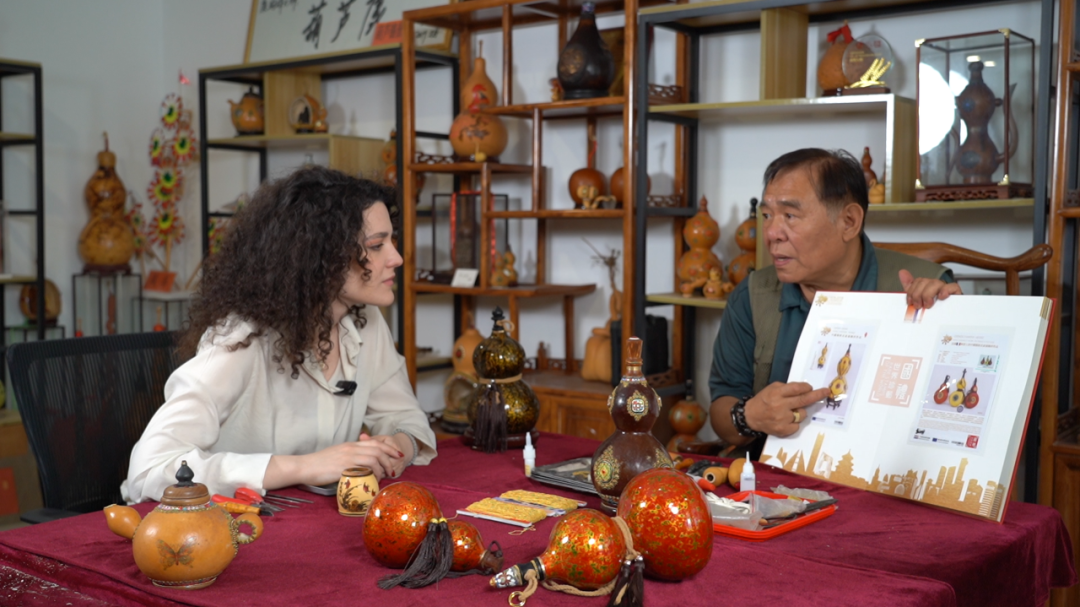
康驹祥向塞尔维亚教师优万娜介绍葫芦镶嵌作品
Kang Juxiang introduces gourd inlay works to Serbia teacher Jovana
真正让这门手艺“亮”出来的,是影视作品。上世纪八十年代,《西游记》《红楼梦》等剧组赴京寻找合适的葫芦道具,经人推荐找到他。他捧剧本研读数日,反复揣摩人物气质。最终他选了一个腰粗口小的葫芦,先烙云纹,银丝收口,于葫芦肚嵌小块青金石。剧组来人一眼看中“就是这个味!”这只无台词的葫芦,悄然将老手艺带入无数家庭电视机里。
What truly brought the craft into the spotlight was film and television. In the 1980s, production teams for series such as Journey to the West and Dream of the Red Chamber, and others came to Beijing seeking suitable gourd props. Recommended to him, Kang studied the scripts for days, carefully weighing the personalities of the characters. He chose a gourd broad in the middle and narrow at the mouth, first branding cloud patterns, finishing the rim with silver wire, and inlaying a small piece of lapis lazuli into the belly. The crew instantly approved “This is exactly the right feel.” That wordless gourd quietly carried the old craft into millions of homes via television.
2002年退休后,他迁居三间房,将几间平房改作工作室,全心投入葫芦。在朝阳区三间房乡党群服务中心支持下,非遗工作室渐次建成。架上摆满历年作品:酒壶、佛造像、花草、动物诸系列,及文房专用水滴。其中水滴最见巧思:葫芦壁极薄,全手工打磨,需盛水且倒得稳,“得顺葫芦物理,较劲不成”。
After retiring in 2002, Mr. Kang moved to Sanjianfang, converting several single-story houses into a dedicated studio, and devoting himself fully to gourd work. With support from the Sanjianfang Township Party–Mass Service Center in Chaoyang District, an intangible cultural heritage studio gradually took shape. Shelves now displays works from decades: wine pots, Buddhist statues, floral and animal series, and scholar’s desk water droppers. The water droppers reveal the greatest ingenuity: the gourd’s walls must be shaved extremely thin, hand-polished to both hold water and pour steadily. “You must follow the gourd’s nature,” Mr. Kang says. “Force never works.”
葫芦镶嵌看似精巧,实则却是一门“笨功夫”。一件复杂作品,从选葫芦到完工,常需二十余日。葫芦壁薄忌火,唯靠时间与手感令材料自然凝固;银丝需用铜银反复拉制,既要有力道,又不能生硬;颜色则沿用古法,青金石等矿石磨粉,以传统胶料粘合,可历百年而不褪。康老先生常说:“这活儿,没十几年下不来。”如今,此类葫芦镶嵌,全国已难觅第二家。
Gourd inlay looks delicate but is in truth a “slow and painstaking craft”. A complex piece can take over twenty days from selecting the gourd to completion. The thin gourd wall cannot tolerate fire; it relies on time and tactile control for materials to set naturally. Silver wire is drawn repeatedly from copper and silver, requiring strength without stiffness. Colors follow ancient recipes: minerals like lapis lazuli are ground to powder and bonded with traditional adhesives, able to endure a hundred years without fading. Mr. Kang often says, “This work takes more than ten years to master.” Today, few if any other places in China continue this particular style of gourd inlay.
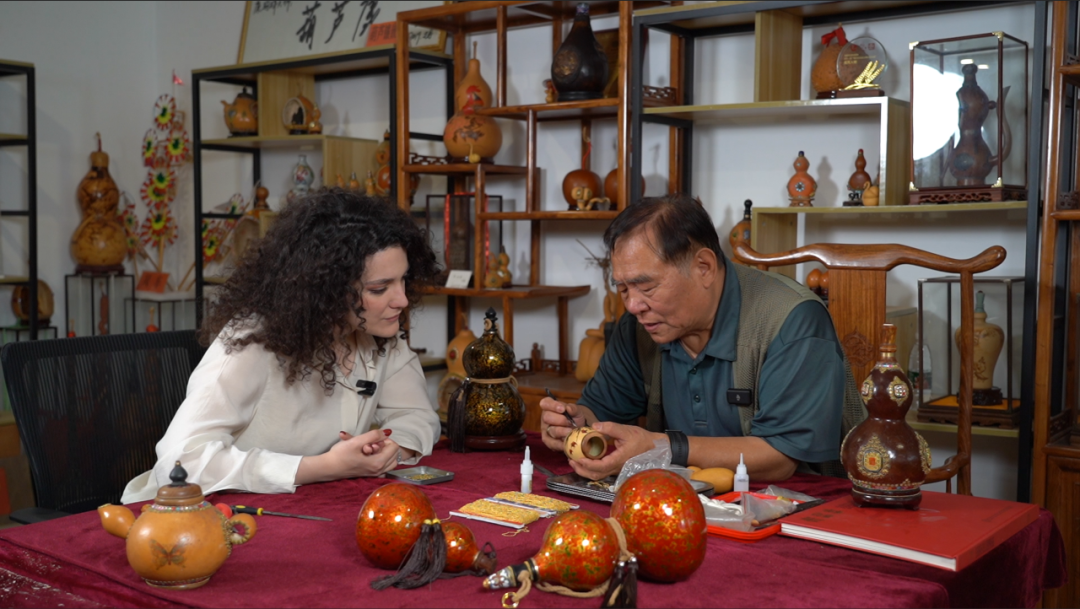
康老先生向优万娜讲解葫芦镶嵌技艺
Mr. Kang explains the technique of gourd inlay to Jovana
技艺不止于“守”,康驹祥亦不断“跟形式”。他有自己的葫芦种植基地,自种子开始介入:生长过程中用绳子、木板定型,自制模具,令葫芦自然生长呈多样姿态。哪吒、冰墩墩及诸吉祥物,皆被他“长”入葫芦。凭经验,他甚至可观种子判未来形制大小。葫芦为草本,生长周期长,无论大小,三月方熟,“急不得”。
Yet preserving this craft is not enough—Kang Juxiang also adapts to the changing times. He runs his own gourd plantation, intervening from the seed stage: during growth, he shapes the gourds with ropes, wooden boards, and customed molds so that they develop into different shapes naturally. Nezha, Bing Dwen Dwen (the Olympic mascot), and other auspicious symbols have been “grown” into the gourds. Drawing on experience, he can even judge future size and shape from a seed. Being herbaceous, gourds have a long growing cycle; whether large or small, they need about three months to mature — “ Do not rush them.”
而比技艺更重要的,是传承。多年来,他陆续收徒十余位,年龄跨越三代。每逢周末,工作室便热闹非常:大学生、退休老人、社区孩童围坐一桌,从烙画到镶嵌,一笔一划学起。他屡赴社区、学校开班授课;在庙会展摊现场展示,向外宾讲解推介作品。
More important than the craft itself is its transmission. Over the years, Mr. Kang has taken on more than ten apprentices across three generations. On weekends, the studio brims with life: university students, retired elders, and neighborhood children gather around a table, learning stroke by stroke from pyrography to inlay. He frequently teaches in communities and schools, sets up booths at temple fairs, and introduces his work to foreign visitors.
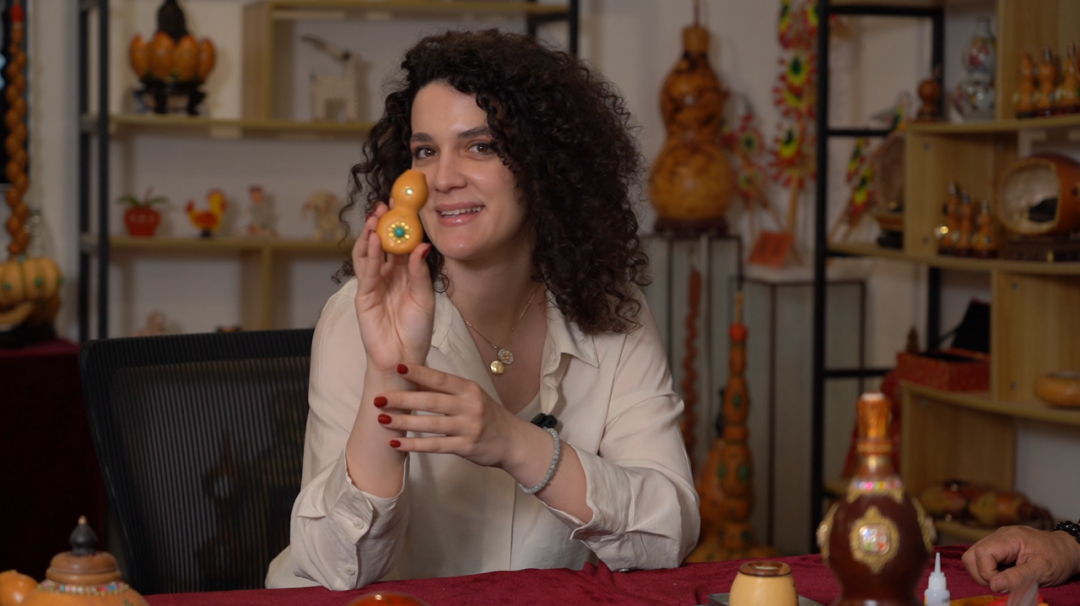
优万娜亲身体验葫芦镶嵌制作
Jovana makes a gourd inlay craft on her own
“艺不压人”,这是他常挂在嘴边的话。身为五十多年党龄的老党员,他更愿自称“发挥余热之人”。他更扶持河北大城葫芦种植户,渐成专业村:地上种粮食,半空种葫芦,小小植物被赋予了更高的经济文化价值。
“Skills are never burdens” is a phrase he often repeats. As a Party member of more than fifty years, he prefers to describe himself simply as “someone putting remaining warmth to use.” He has also supported gourd growers in Dacheng Village, Hebei Province, helping form a specialized village—grain grows on the ground, gourds hang above. A humble plant has been given higher economic and cultural value.
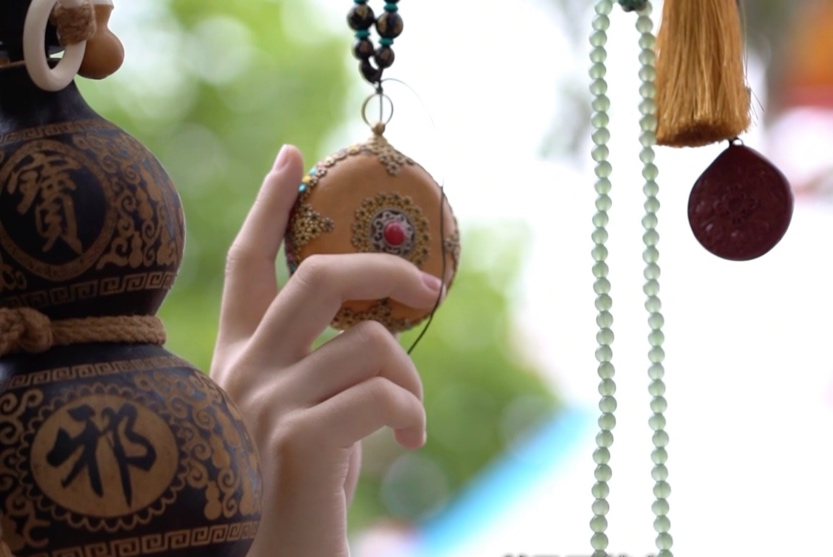
市集里游客欣赏康老先生的葫芦镶嵌作品
Visitors admire Mr. Kang’s gourd inlay works at a market
康老先生今年75岁,熟人皆言其“实在、局气”。他乐与年轻人想法相合,亦始终保交流、勤学习——与山东聊城等地匠人互通有无,令手艺于流动中延续。
Now 75, Mr. Kang is known among acquaintances as true and generous. He enjoys exchanging ideas with younger generation and remains open to learning—sharing techniques with artisans from places like Liaocheng, Shandong—so that the craft endures through movement and connection.
傍晚,夕阳透窗,洒满屋中葫芦,镀出一层温暖光晕。康老先生将当日所成“福禄”小挂件摆窗边,风一吹,葫芦轻轻晃动,发出细碎声响。窗外童声笑语传来,与屋内声响交织。那些藏于葫芦的故事,遂渐自一间工作室向远方。它们静而不寂,藏意于形;淡而不寡,余韵绵长。正于这流动与传播中,老手艺不再只是被保存的记忆,而成为仍在生长之文化——被一代代人接住,亦被世界一次次回应。
At dusk, sunlight streams through the window, bathing the gourds in the room with a warm glow. Mr. Kang places the day’s finished a small gourd craft Fu Lu (Fu for blessing, Lu for prosperity) by the window. A breeze sets the gourd swaying gently, releasing soft rustling sounds. Outside, children’s laughter blends with the indoor tones. And the stories hidden inside the gourds gradually travel from one studio into the wider world. Silent but not lifeless, they store meaning in form; subtle but not sparse, their lingering charm spans time. In this flow and spread, the old craft is no longer mere preserved memory, but a living culture—received by generation after generation, and echoed again and again by the world.
监 制:庄 阳 蔡晓娟 李海青
制片人:唐恩思 刘 颖
总导演:马宪超 崔 倩
中文审校:唐恩思
英文审校:孙 婧
摄制统筹:崔 润
摄 像:韩汶霖 岳 鸿 张师萌 李炜翔 洪羽萱
剪 辑:黄心怡 李炜翔
撰 稿:胡子彦

北京第二外国语学院
来源丨党委宣传部
翔宇国际传播人才培养基地
编审丨黄佳丽
审定丨唐恩思
若需转载 敬请联络